A film · 5 min 50 s · Sound on
Jane’s Ticket
The argument of Superjustice, told through the book’s own two stories.
Three parts, each of which stands alone. The page of the book for every line comes after.
In Three Parts
- 0:00 Part 1 · Chapter 2 Jane’s ticket One parking ticket, followed through the ten failures the book names, then run again in a redesigned system.
- 1:48 Part 2 · Chapter 3 Sarah, Tom, and the oak tree A quarrel between neighbours, too small for today’s courts, settled in a redesigned system.
- 3:52 Part 3 · Chapters 9 and 10, and the Conclusion Six questions The book’s test for a redesign, put to Jane’s ticket, and the book’s warnings.
The Book’s, and the Film’s
The book makes its argument through people. In chapter 2, Jane, new in town, contests a parking ticket she believes is unfair. In chapter 3, Sarah asks her neighbour Tom to trim the oak whose birds wake her every morning. The film follows both stories, then turns the six principles of the book’s framework, CRISPR-J, into six questions and puts them to Jane’s ticket.
The claims are the book’s, and almost all of the words are the film’s: the narration paraphrases throughout. The list below gives the page of the book for each line, and says where a phrase, a line or a picture is the film’s own. Two lines stay close to the book’s words: the question the book ends on, and by humans, for humans, with AI.
A film of this length leaves things out. The book’s sketch of Jane’s app runs on blockchain and smart contracts; the film says only that she asks her AI agent. The book adds that invented citations are already rarer in newer models, and it expects human oversight to shrink as AI proves reliable; the film says neither. The real dispute the book describes, in Dripping Springs, Texas, is not in the film. Where the film compresses, the book governs.
The film was made on 12 and 13 November 2026 by Claude, an AI model made by Anthropic. The authors asked for a second film, longer and deeper than Exhibit A, and gave the model the text of the book. The model wrote the script from it, with the page of the book beside every line, and then wrote the program that draws the film. The voice is synthetic.
The authors chose to publish it. The argument is theirs. The script, the drawing and the score are the model’s.
Exhibit A is the first film. The book is the argument in full.
On the Gates
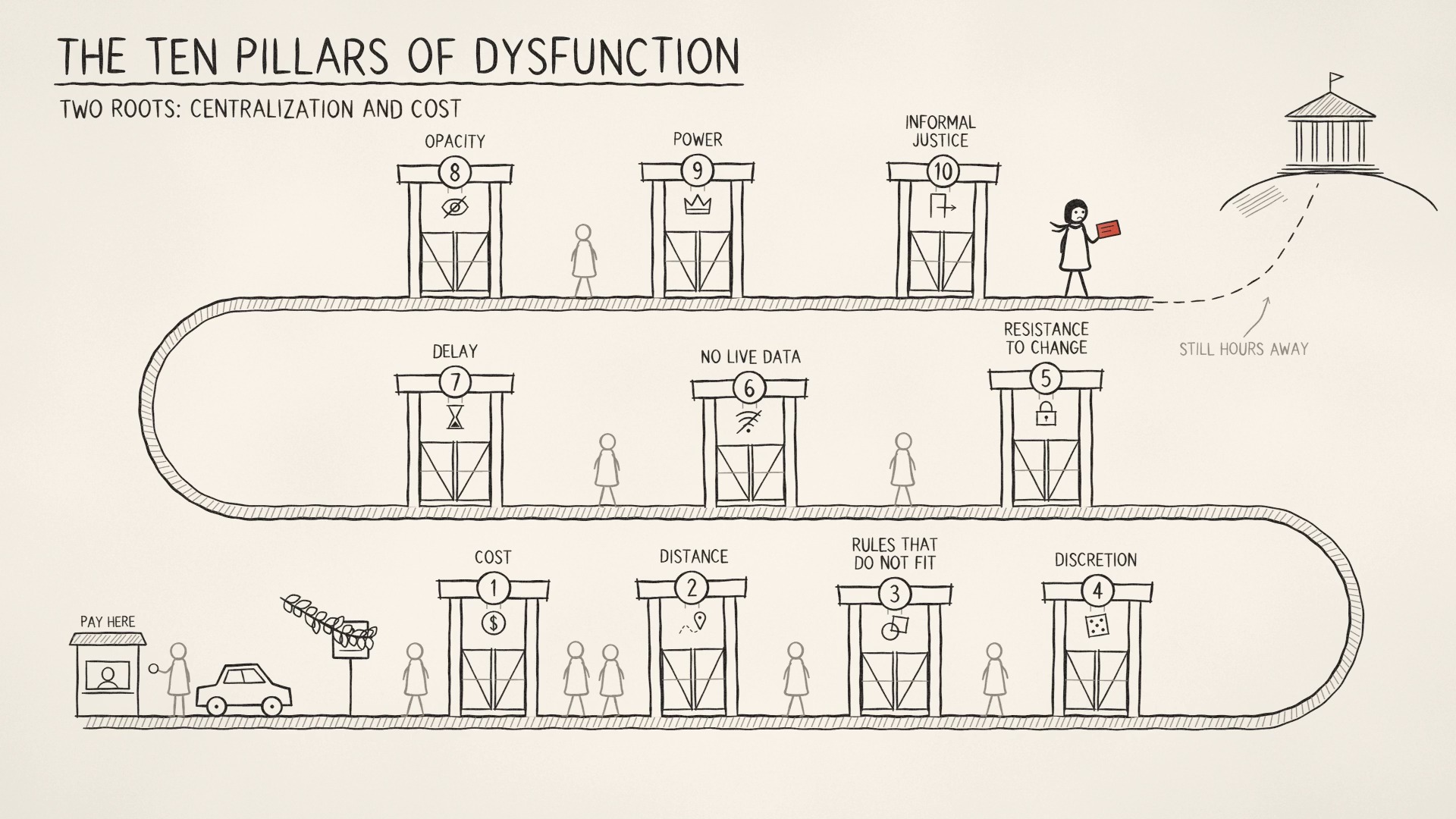
The ten gates in Part 1 are the book’s Ten Pillars of Legal Dysfunctionality. The film shortens each name to fit a gate. The book’s name for each, and the page where it begins, are beside it.
- 1CostProhibitive costs and access to justice, p. 33
- 2DistanceGeographic barriers and global legal fragmentation, p. 36
- 3Rules that do not fitOver- and under-prescription, p. 38
- 4DiscretionInconsistencies and discretion issues, p. 39
- 5Resistance to changeResistance to innovation and change, p. 41
- 6No live dataUnresponsiveness to real-time data, p. 42
- 7DelaySlow response times and case overload, p. 43
- 8OpacityOpaque processes and accountability gaps, p. 44
- 9PowerConcentration of power and bias, p. 46
- 10Informal justiceInformal justice, p. 47
How It Was Made
The film is drawn by a program. Every picture is drawn stroke by stroke, and the lettering comes from the same pen: no font is used. There are 10,486 frames, thirty for each second.
It is black line on paper, with two colours. Red marks what is wrong: Jane’s ticket, the birdsong that wakes Sarah, and the book’s two warnings. Gold marks what puts it right, beginning with the AI agents and their answers. The one picture the program did not draw is the book’s cover, on the end card.
The narration is 768 words in 34 lines, and the list below cites 37 pages of the book for them. The voice is synthetic: Benjamin Alarie generated it from the script with ElevenLabs, a text-to-speech service, in one recording for each part. Each drawing is timed to the pauses in those recordings.
The score is synthesized: a quiet piano under the voice, in a new key for each part, with a small bell on each gold tick and a soft swish on each turn of the page. No instrument was recorded.
Written, drawn, and scored by Claude, an AI model made by Anthropic, from the text of the book, at the request of Samuel I. Becher and Benjamin Alarie. Narrated by a synthetic voice.
What It Says, and Where
Every line of the narration, in the order it is spoken, with the page of the book it comes from. A note says where a phrase, a line or a picture is the film’s own, and where the book says more. Some lettering on screen shortens the spoken line. Choose a time to play the film from that line.
Part 1 Jane’s ticket
- 0:05 This is Jane. Spotless record, new in town, and holding a parking ticket she believes is unfair. The sign was unclear. Superjustice, ch. 2, pp. 31 and 39.
- 0:14 So she does what a careful person does. She contests it. Superjustice, ch. 2, p. 31.
- 0:19 Hours on the phone, passed from one department to the next. A written appeal, rejected. Then a day off work, and a court a few hours’ drive away. Superjustice, ch. 2, p. 31.
- 0:30 Follow her ticket, and you meet ten things that are wrong with far more than parking. Superjustice, ch. 2, p. 33; The Ten Pillars of Legal Dysfunctionality, in full. The film draws the ten as gates on a road and shortens their names. The book calls them the Ten Pillars of Legal Dysfunctionality, and names each in full.
- 0:36 It costs too much: time, money, and energy, for a small dispute. It is too far away. The rule has no room for a newcomer and a confusing sign. And her ticket may be pursued while others like it are let go. Superjustice, ch. 2, pp. 35–36 and 39–40. The book gives the fourth as a possibility, and so does the film.
- 0:52 The system resists the tools that would have prevented all this. It ignores what could be known in real time. It is slow. It is opaque: Jane never learns who has her case, or when it will end. And a few people decide for everyone. Superjustice, ch. 2, pp. 41–46.
- 1:10 Jane kept going. Most people would pay the fine and give up. Superjustice, ch. 2, p. 47. The pay window where the road begins is the film’s picture. The book makes the point under its tenth pillar, informal justice.
- 1:14 None of this is an accident. All ten grow from two roots: a system run from the centre, and work that takes expensive expert time. Superjustice, ch. 2, pp. 33–34. Two roots is the film’s phrase, lettered under the title. The book says the ten pillars show how centralization and high costs burden the system.
- 1:24 So run it again. Jane photographs the sign and asks her AI agent to appeal. A prompt, transparent decision comes back. If the sign really was unclear, the fine is dismissed, or cut to fit her circumstances. Either way, she knows why. Superjustice, ch. 2, p. 49. The book tells Jane’s story a second time, in a Superjustice system: the fine is waived or reduced if her confusion was legitimate. Either way, she knows why is the film’s gloss on the book’s transparent decision. The book’s sketch of her app, on the chapter’s first page, runs on blockchain and smart contracts, which the film leaves out.
- 1:42 Same Jane. Same ticket. A different design. Superjustice, ch. 2, p. 49. The line is the film’s. It sums up the book’s second telling of Jane’s story.
Part 2 Sarah, Tom, and the oak tree
- 1:52 This is Sarah. Every morning she is woken by the birds in her neighbour Tom’s old oak tree. Its branches hang over her garden. Superjustice, ch. 3, p. 50.
- 2:02 She asks Tom to trim it. Tom loves the birds, and the shade. He says no. Superjustice, ch. 3, p. 50.
- 2:08 She offers to split the cost, tries mediation, suggests birdhouses. Nothing works. And a lawyer, steep fees, and months of delay, for a few branches, feels absurd. Superjustice, ch. 3, p. 50.
- 2:22 You may side with Sarah. Or with Tom. Either way, neither can get an answer worth its cost. Superjustice, ch. 3, p. 50. The last sentence is the film’s. The book says that going to law over a few branches feels absurd.
- 2:30 Law became centralized for good reasons: one authority, and the same rules for everyone. Superjustice, ch. 3, pp. 50–52.
- 2:37 But there is another way: a hybrid. Keep the centre for the principles and rights that must hold everywhere. Move everyday disputes closer to the people in them. Superjustice, ch. 3, pp. 66 and 73.
- 2:49 So Sarah tells her AI agent what she wants: quiet mornings. Tom’s agent protects his tree. Bargaining through agents costs far less, so they find what the neighbours never did: a price both can accept. Sarah would pay up to $300. Tom would take $250 to trim certain branches. Superjustice, ch. 3, pp. 63–64. Quiet mornings is the film’s phrase: in the book, Sarah asks her agent to stop the birds waking her. What the neighbours never did is the film’s too: the book says that lower bargaining costs open the way to a deal. The $300 and the $250 are the book’s figures.
- 3:12 And if it has to be decided? Where the rule is clear, an answer comes in minutes. Where it is vague, arbitrators from their own community weigh in, and it takes days. Not months. Superjustice, ch. 3, pp. 66 and 69. If it has to be decided is the film’s hinge: the book sets bargaining and deciding side by side. Not months is the film’s too. The book has days with human arbitrators and minutes with AI.
- 3:25 They might settle on trimming part of the tree. Or on keeping the birds at a distance. Superjustice, ch. 3, p. 60.
- 3:31 One more question: who speaks for the birds, and for the oak? Superjustice, ch. 3, pp. 67–68. One more question is the film’s. The book raises the birds and the oak as a question of scope.
- 3:36 And the centre still stands: rights no local majority can override, a right to appeal, and an agent provided for anyone who cannot pay for one. Superjustice, ch. 3, pp. 67–68 and 70; The proposal, and the objections to it.
- 3:47 Sarah and Tom are still neighbours. Superjustice, ch. 3, pp. 73–74.
Part 3 Six questions
- 3:55 It is 2050. An entrepreneur accuses a global tech company of stealing an invention. Two AI agents argue the case. An AI arbitrator decides it in seconds. Superjustice, ch. 10, p. 207.
- 4:09 To some, a marvel. To others, unsettling. Who chose its values? Can anyone ask a human to look again? Superjustice, ch. 10, p. 207.
- 4:18 Those are the right questions. A faster version of the old system is not the goal. Superjustice, ch. 2, p. 31; Superjustice, Conclusion, p. 231. The rocket is the film’s. The old, creaky car is the book’s picture of today’s legal system.
- 4:25 So here is a way to tell the difference. It borrows a name from gene editing: CRISPR, a tool that fixes one fault precisely and leaves the rest intact. Superjustice, ch. 9, pp. 183–184.
- 4:36 CRISPR-J asks six things of any redesign. Hold them against Jane’s ticket. Superjustice, ch. 9, pp. 183–184; CRISPR-J, with each principle defined and applied. The book calls them six core principles. Putting them to Jane’s ticket is the film’s.
- 4:43 Did it cost her less than the fine? Was it settled the same day? Did it make room for a newcomer? Did it use the photo of the sign? Was the sign fixed for the next driver? And will it stay fair as things change? Superjustice, ch. 9, p. 184. The six questions are the film’s. With each, the film letters the book’s name for the principle: cost-effectiveness, rapidity, inclusivity, smartness, predictiveness, and resilience. The page cited is where the book defines the six; it applies them to its own case studies in chapter 9, not to Jane’s ticket.
- 4:59 None of this is a cure-all. AI learns from the past, and can repeat its biases, or enlarge them. It can cite a case that does not exist. Superjustice, ch. 9, p. 184; Superjustice, ch. 10, p. 209. The book adds, on the next page of chapter 10, that invented citations are already rarer in newer models. The film does not say so.
- 5:10 So people stay at the centre. There is a right to appeal, and human oversight where the stakes are high. Superjustice, ch. 1, p. 22; Superjustice, ch. 3, p. 68; Superjustice, ch. 5, p. 116. The book goes on, on the next page of chapter 1, to expect human oversight to shrink as AI proves reliable. The film keeps to the high-stakes cases.
- 5:17 The book behind this film ends by turning the question around. Not: what will AI do to law? But: what do we want it to do? Superjustice, Conclusion, p. 230. The film stays close to the book’s own words here. Where the film has law, the book has our legal systems.
- 5:28 That takes will, more than technology. Superjustice, Conclusion, p. 231.
- 5:31 From justice that is scarce to justice that is abundant. By humans, for humans, with AI. Superjustice, Conclusion, p. 231; Superjustice, Introduction, p. 7. By humans, for humans, with AI is the book’s phrase.
- 5:39 The book is Superjustice. The Book. On the end card: the book’s cover and title, its authors, Oxford University Press, superjustice.com, and the credit, which reads: Drawn by code written by Claude. Narrated by a synthetic voice.