A film · 1 min 46 s · Sound on
Exhibit A
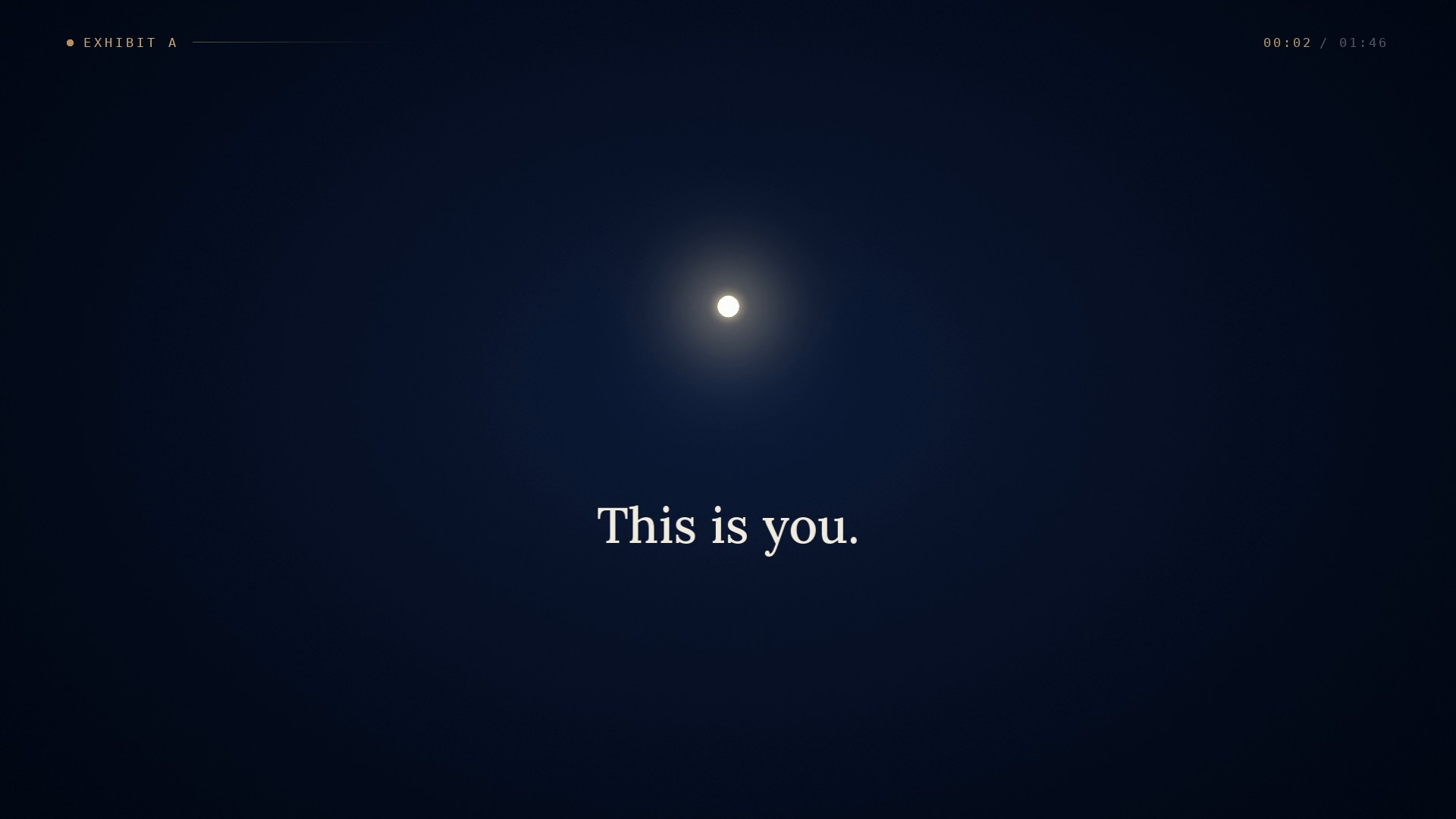
A film about Superjustice, entered into evidence.
Watch it before you read on. What it is evidence of comes after.
What It Is Evidence Of
No camera recorded this film, and nobody drew it, edited it, or played its music. At the authors’ request, an AI model, Claude Fable 5.2, made by Anthropic, wrote it, designed it, animated it, and composed and synthesized its score, in a single working session on 11 November 2026.
That is what the film is evidence of. Work of this kind has needed a writer, a designer, an animator, and a composer. This time it needed a request. The book makes the wider point on its second page: what AI is doing to expertise is not confined to law. The first of its twelve claims, as the authors number them on this site, says it of legal work, with more care: AI is expanding the supply of legal reasoning faster than legal institutions are adapting to it.
It is not evidence that justice follows. A film is not a judgment, and nothing in it was tested by a court. The second claim is that an expanded supply of legal reasoning does not by itself produce justice, and the third is that the scarcity of justice is substantially a design outcome, and what was designed can be redesigned. The redesign is what the book is about.
The model made the film from what the authors have published and presented about the book: this site, their articles LexOptima: The Promise of AI-Enabled Legal Systems and Legal Order in the Age of AI Agents, and the slides of a keynote by Benjamin Alarie. It was given the text of the book once the film was finished, and checked each line of the film against it. Where the book says it, the list below gives the page; where it does not, the list says so. The film contains no footage, no stock, and no recorded sound; the one picture the program did not draw is the book’s cover.
The authors asked for the film, supplied its sources, and chose to publish it. The argument it compresses is theirs; the compression is the model’s.
How It Was Made
The film is a program. One function takes a moment in the film and returns the picture for that moment. It was run 3,180 times, thirty for each second, and nothing is carried from one frame to the next.
The 7,700 points of light are a count. Each stands for one million people, 7.7 billion in all, roughly the world’s population in 2019, the year of the World Justice Project’s estimate. The 5,100 that stay dark are the 5.1 billion people the Project estimated to have unmet justice needs, and the point the film calls you is one of them. Where the dark points fall is random: it is not a map of anywhere. The same 7,700 points go on to form everything else in the film: a temple with ten pillars, its collapse, a double helix, a globe, and the title.
The score is 715 sound events: 412 notes for seven synthesized instruments, and 303 drum hits and effects. No instrument was recorded and no sample was used. It is in D minor until the word Redesign and in D major after it, and the four notes that open the film return at its end with one of them raised.
At 0:28 the film shows its own source and its own score. The lines of code on screen are lines of the program that is drawing them, and the notes are the ones being played.
The typefaces are Lora, Inter, TeX Gyre Heros, and DejaVu Sans Mono. The tools are Python, NumPy, SciPy, OpenCV, Pillow, and FFmpeg. The program is 2,682 lines of Python, and the captions and the list of lines below are generated from the same script the picture is drawn from.
Written, designed, animated, and scored by Claude Fable 5.2, an AI model made by Anthropic, at the request of Samuel I. Becher and Benjamin Alarie.
What It Says, and Why
Every line of the film, in the order it appears, with the place it comes from: the page of the book, and the authors’ statement of it on this site. A proposition is one of the twelve numbered claims in The Argument. Where the film compresses, the source governs. Choose a time to play the film from that line.
- 0:01 This is you. You were wronged, and you can prove it. Proving it costs more than you would win. So you let it go. Superjustice, ch. 2, pp. 31–36 and 47; Superjustice, ch. 9, p. 199; The Ten Pillars of Legal Dysfunctionality, pillars 1 and 10. The person is an illustration, not a case. The book’s own is Jane, who contests a parking ticket she believes unfair; under pillar 10 it adds that most people would pay the fine and give up the claim.
- 0:16 One point of light: one million people. Dark: unmet justice needs. Lit: everyone else. 5,100,000,000 people have unmet justice needs. Two in three people on Earth. World Justice Project, Measuring the Justice Gap (2019); Superjustice, ch. 6, p. 123. The Project’s figure is 5.1 billion people, approximately two thirds of the world’s population. The book gives the same figure from the same report.
- 0:20 Justice is rationed. Less by nature than by design. For a world where expert reasoning was scarce. Superjustice, Introduction, p. 1; Superjustice, Conclusion, p. 231; Proposition 3. Rationed is the film’s word. The book says that legal systems are still tied to frameworks made for an earlier technological era, and calls for a move from scarcity to abundance. The proposition’s own word is substantially.
- 0:28 Exhibit A: this film. No camera. No crew. No composer. Written, designed, animated, and scored by an AI. In one sitting. How It Was Made, on this page. On screen: lines of the program that draws the film, and the score as it plays.
- 0:39 Expert reasoning is becoming abundant. Justice is not. Superjustice, Introduction, pp. 1–2; Proposition 1; Proposition 2. The first proposition is about legal reasoning, and the film’s line is broader. The book makes the broader point too: what AI is doing to expertise reaches almost every profession.
- 0:45 Legal systems fail in ten structural ways. 1. Prohibitive costs. 2. Geographic barriers and fragmentation. 3. Over- and under-prescription. 4. Inconsistency and discretion. 5. Resistance to innovation and change. 6. Unresponsiveness to real-time data. 7. Slow responses and case overload. 8. Opaque processes, accountability gaps. 9. Concentration of power and bias. 10. Informal justice. Superjustice, ch. 2, pp. 33–48; Proposition 5; The Ten Pillars of Legal Dysfunctionality, in full. The film shortens the pillars’ names. The book and the site give each in full.
- 0:50 Digitize them as they are, and they fail faster. Post Office Horizon, United Kingdom. Childcare benefits scandal, The Netherlands. Fast. Consistent. Wrong. Superjustice, ch. 1, p. 11; Superjustice, ch. 10, p. 209; Proposition 4; Hamilton v Post Office Ltd [2021] EWCA Crim 577; Unprecedented Injustice (Ongekend onrecht), the report of the Dutch parliamentary inquiry on childcare allowance, 2020. The book says that Superjustice is not a matter of digitizing outdated hierarchies, and that AI can carry forward and enlarge the biases in what it learns from. The two examples are not in the book: they, and the lesson drawn from them, are from Benjamin Alarie’s keynote slides. The court’s judgment and the inquiry’s report are linked for what happened.
- 0:57 AI will transform law. It will not automatically produce justice. The book’s thesis; Superjustice, Introduction, p. 1; Superjustice, Conclusion, p. 231. The sentence is this site’s. The book says that the promise needs more than technical ingenuity, and that its success depends on collective will, not on technology.
- 1:03 So do not digitize. Redesign. Six tests for any legal system: cost-effective, rapid, inclusive, smart, predictive, resilient. J is for Justice. Superjustice, ch. 9, pp. 183–184; Superjustice, ch. 1, p. 11; Proposition 4; Proposition 10; CRISPR-J, with each principle defined and applied. The book calls them six core principles. Tests is the film’s word, after the applied tests on this site. The book states that CRISPR-J is not a panacea.
- 1:15 Then justice can become abundant. Disputes: resolved in minutes, not months. Rules: fitted to your circumstances, and fair. An AI legal agent: for everyone, as a right. Human judgment: at the core. Superjustice, Conclusion, p. 231; Superjustice, ch. 3, pp. 60 and 70; Superjustice, ch. 9, pp. 191–196; Superjustice, ch. 1, p. 22; Superjustice, defined; Becher and Alarie, Legal Order in the Age of AI Agents, University of Toronto Law Journal (2026); Proposition 6; The proposal, and the objections to it; Proposition 8. What the authors argue a redesigned system could do, not a forecast. Minutes, not months is the article’s phrase; the book’s example is a dispute between neighbours settled almost at once. The book says a hybrid system might make AI representation a right, through publicly provided AI legal agents.
- 1:25 By humans, for humans, with AI. Not what AI will do to law. What we want it to do. Superjustice, Introduction, p. 7; Superjustice, Conclusion, p. 230; Proposition 8; Proposition 12. Both lines are the book’s own. Where the film has law, the book has our legal systems.
- 1:34 Superjustice: Law in the Age of Artificial Intelligence. Samuel I. Becher and Benjamin Alarie. Oxford University Press. Out now in print, ebook, and audio. Exhibit B: the book. superjustice.com. Exhibit A, this film: written, designed, animated, and scored by Claude Fable 5.2. The Book.